The Payday Library weekly: what the data says about starting, pricing and running a small business (October 26, 2026)
2026-10-26
Every number here comes from free public data published by the U.S. government, pulled and checked by our scripts. Sources are linked at the end.
Pricing: who can raise prices
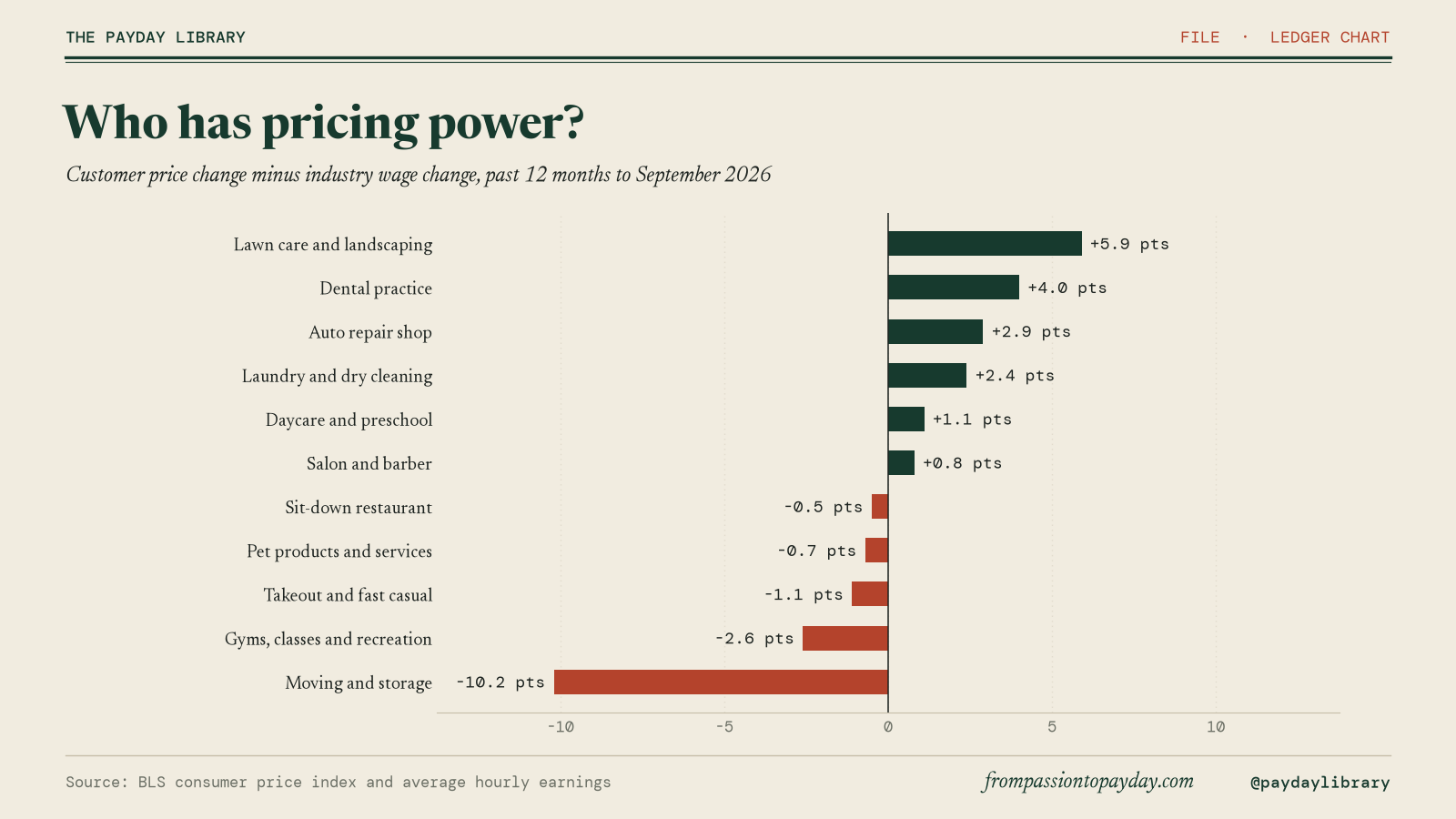
Across 11 small-business services, we compare what customers pay (the consumer price index) with what each industry pays its staff (average hourly earnings), over the 12 months to September 2026. Overall prices rose 3.7%.
- Lawn care and landscaping: prices +8.8%, pay +2.9%, gap +6.0 points
- Dental practice: prices +6.0%, pay +2.0%, gap +4.0 points
- Auto repair shop: prices +5.8%, pay +2.9%, gap +2.9 points
- Laundry and dry cleaning: prices +5.3%, pay +2.9%, gap +2.4 points
- Daycare and preschool: prices +3.1%, pay +2.0%, gap +1.2 points
- Salon and barber: prices +3.7%, pay +2.9%, gap +0.8 points
- Sit-down restaurant: prices +3.8%, pay +4.3%, gap -0.6 points
- Pet products and services: prices +2.2%, pay +2.9%, gap -0.8 points
- Takeout and fast casual: prices +3.2%, pay +4.3%, gap -1.1 points
- Gyms, classes and recreation: prices +1.3%, pay +3.9%, gap -2.6 points
- Moving and storage: prices -7.1%, pay +3.1%, gap -10.2 points
What it means: lawn care and landscaping owners have the most room to raise prices without falling behind on wages. Moving and storage is the most squeezed: if you run one, cost control matters more than price this year.
New competition: where Americans are starting businesses
534,947 business applications were filed in September 2026 (seasonally adjusted), +4.4% on a year earlier.
- Media and software: 13,806 applications, +49.2% on a year earlier, 11.5% likely to hire
- Manufacturing: 8,114 applications, +30.3% on a year earlier, 31.3% likely to hire
- Professional services: 78,937 applications, +20.3% on a year earlier, 21.3% likely to hire
- Wholesale: 9,997 applications, +17.1% on a year earlier, 22.9% likely to hire
- Cleaning, landscaping and admin services: 38,030 applications, +16.0% on a year earlier, 12.9% likely to hire
- Education and tutoring: 8,554 applications, +14.1% on a year earlier, 12.9% likely to hire
- Transportation and delivery: 34,792 applications, +13.1% on a year earlier, 14.8% likely to hire
- Finance and insurance: 20,548 applications, +9.7% on a year earlier, 29.4% likely to hire
- Construction and trades: 48,078 applications, +9.1% on a year earlier, 50.5% likely to hire
- Fitness, arts and recreation: 15,180 applications, +8.0% on a year earlier, 10.6% likely to hire
- Mining: 569 applications, +6.2% on a year earlier, 18.6% likely to hire
- Farming, forestry and fishing: 3,892 applications, +6.0% on a year earlier, 14.0% likely to hire
- Repair, salons and personal services: 42,149 applications, +5.2% on a year earlier, 12.3% likely to hire
- Health care and childcare: 32,198 applications, +2.6% on a year earlier, 67.2% likely to hire
- Utilities: 540 applications, -1.8% on a year earlier, 9.6% likely to hire
- Restaurants, cafes and lodging: 26,600 applications, -2.3% on a year earlier, 100.0% likely to hire
- Real estate and rentals: 23,857 applications, -5.0% on a year earlier, 8.5% likely to hire
- Retail and online stores: 110,048 applications, -13.6% on a year earlier, 19.2% likely to hire
By state, over the latest four weeks of weekly data, the fastest growth was in Missouri (+40.4%), Utah (+23.8%), Oklahoma (+13.0%), Connecticut (+9.3%), New Jersey (+7.9%); the slowest in Tennessee (-17.6%), Hawaii (-22.6%), Nevada (-24.4%).
What it means: a jump in applications in your industry or state means more new competitors in a year or two. Industries with few new applicants are where an entrant faces the least new competition.
How they make money: public companies running small-business models
Operating profit per $1 of sales in their latest full year, from their annual reports filed with the SEC.
- Planet Fitness (gym franchise): 29.8 cents per $1, sales +12.1%
- Wingstop (franchised restaurant): 25.7 cents per $1, sales +11.4%
- Cintas (uniform and laundry service): 23.1 cents per $1, sales +8.9%
- Valvoline (quick oil change): 22.8 cents per $1, sales +5.6%
- Domino's (pizza delivery): 19.3 cents per $1, sales +5.0%
- Rollins (pest control): 19.3 cents per $1, sales +11.0%
- Chipotle (fast casual restaurant): 16.2 cents per $1, sales +5.4%
- Ulta Beauty (beauty store and salon): 12.4 cents per $1, sales +9.7%
- Bright Horizons (childcare centers): 10.7 cents per $1, sales +9.2%
- Dutch Bros (drive-thru coffee): 9.8 cents per $1, sales +27.9%
- Etsy (handmade marketplace): 9.2 cents per $1, sales +2.7%
- Texas Roadhouse (sit-down restaurant): 8.1 cents per $1, sales +9.4%
- Starbucks (coffee shop): 7.9 cents per $1, sales +2.8%
- Xponential Fitness (boutique fitness franchise): 6.3 cents per $1, sales -1.7%
- BrightView (landscaping): 5.0 cents per $1, sales -3.4%
- Shake Shack (burger restaurant): 4.3 cents per $1, sales +15.4%
- ABM Industries (commercial cleaning): 3.6 cents per $1, sales +4.6%
- Petco (pet store and services): 2.0 cents per $1, sales -2.5%
- Monro (auto repair chain): 1.7 cents per $1, sales -3.2%
- Sweetgreen (salad restaurant): -20.5 cents per $1, sales +0.4%
What it means: use these as a yardstick for your own numbers. If a company with national scale keeps only a few cents per dollar, a single-location version of the same business has to price carefully to do better.
Sources
- U.S. Bureau of Labor Statistics: consumer price index and average hourly earnings (https://www.bls.gov/data/)
- U.S. Census Bureau: Business Formation Statistics (https://www.census.gov/econ/bfs/)
- U.S. Securities and Exchange Commission: EDGAR company filings (https://www.sec.gov/edgar)
The full tables update as new data is published: https://frompassiontopayday.com/pricing/, https://frompassiontopayday.com/new-businesses/ and https://frompassiontopayday.com/companies/.